
No-Verification Registration: How No-KYC Sites Work and Why It Matters
 Available in GB
“No verification” and “no-KYC” are among the strongest demand drivers behind casinos not on GamStop. This page explains what those terms actually mean, how such sites operate, and the documented way they tend to fail players. It is an explanatory risk page. It does not tell you how to avoid identity checks, and it does not present anonymity as an advantage, because in practice the lack of verification is where the most serious problems begin.
Table of Contents
What KYC is and why UK sites require it
KYC stands for Know Your Customer. It is the set of identity checks a regulated operator runs to confirm who you are: typically proof of identity, proof of address, and source-of-funds checks where relevant. UKGC-licensed casinos are required to perform KYC as a condition of their licence, and they generally do it at or near registration so that an account is verified before significant play.
KYC is not just bureaucracy. It is the mechanism that enforces age limits, supports anti-money-laundering law, and underpins player-protection tools. Crucially, it is also what makes self-exclusion work. The way GamStop matches a registrant against new accounts depends on verified identity data, which is explained on the page covering how GamStop matching works. Remove verification and you remove the hook that lets protection function at all.

How no-KYC offshore registration actually works
A no-KYC offshore site lets you open an account and start playing with minimal identity information, often just an email address. The model is almost always crypto-funded: because deposits arrive as cryptocurrency rather than through a bank or card, the operator can sidestep the identity trail that traditional payments create. The pitch is speed and privacy, and at the sign-up stage that pitch is broadly accurate.
The mechanics are tied directly to payments. A no-KYC site needs a payment rail that does not itself demand identity, which is why crypto and these sites travel together. The same dynamic is examined on the page about crypto and no-KYC payments, which shows why the deposit method and the verification model are really one decision, not two.

The documented failure mode: KYC only at withdrawal
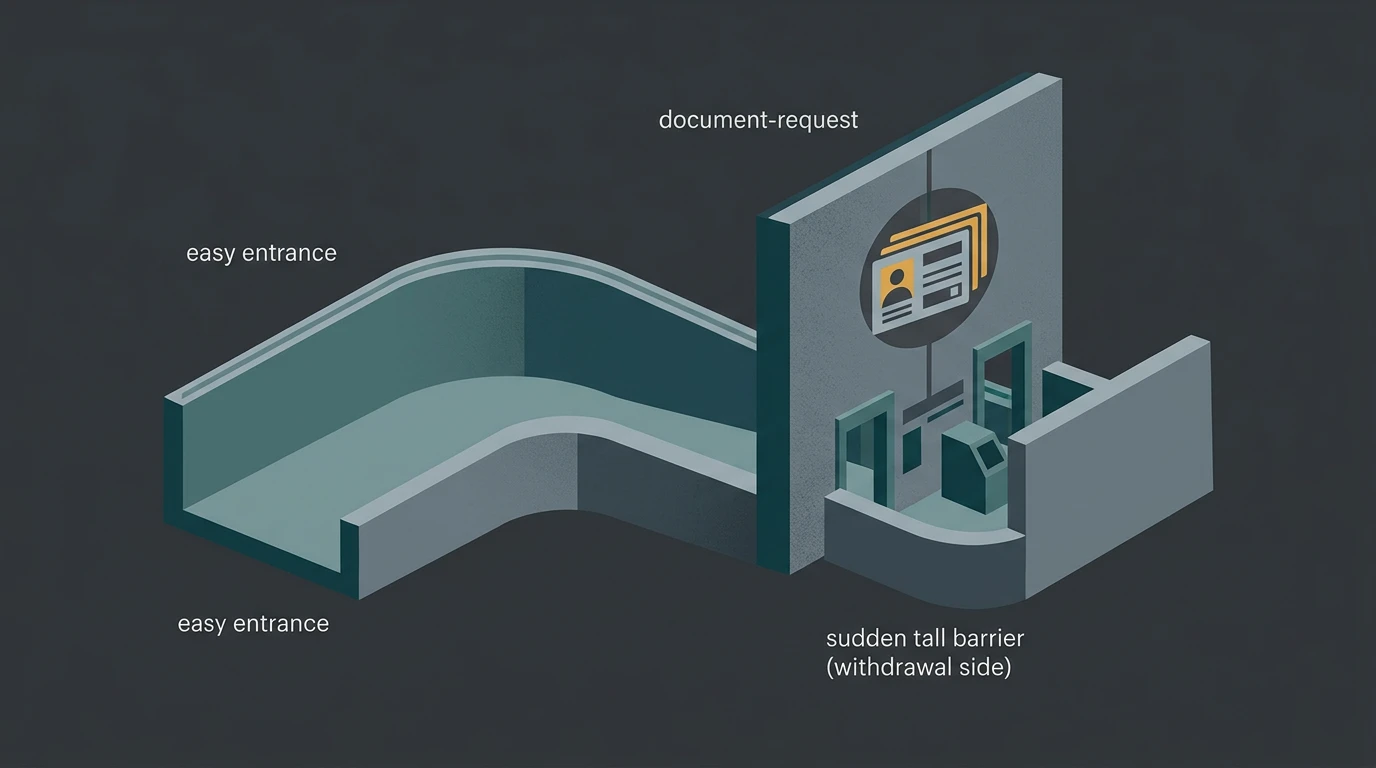
The single most important thing to understand about “no-KYC” sites is that the phrase frequently describes the deposit stage only. A recurring complaint pattern across this market is that verification is demanded not at sign-up, but at the moment a player tries to withdraw. Deposits and play proceed without friction; then, precisely when there is money to pay out, the operator requests documents, or refuses the withdrawal until checks are completed that may never be accepted.
This is not a marginal edge case. It is a structural feature of how some of these sites operate, because deferring KYC to withdrawal maximises deposits while giving the operator a discretionary lever over payouts. A site that asks for nothing on the way in but everything on the way out has effectively reversed the protection KYC is meant to provide. Combined with the absence of UK recourse, a player in this position has very little leverage.
Why “no checks” can mean “checks when it suits the operator”
Front-loaded verification protects the player as much as the operator: it confirms eligibility before any money is at stake. Back-loaded verification protects only the operator, because it can be applied selectively to large or inconvenient withdrawals. The absence of checks at sign-up is not the absence of checks; it is the relocation of them to the point of maximum leverage.
No recoverable trail, and weaker protection for those who need it most
Anonymous crypto play has a second, harder consequence. If funds disappear, there is no recoverable audit trail. The on-chain record shows a transfer left your wallet, but with no verified counterparty and no UK body with jurisdiction, there is no realistic route to recovery. This is the same audit-trail problem that runs through the payments analysis, and it is why anonymity and safety pull in opposite directions.
The deeper harm is to the people the UK system works hardest to protect. Lighter KYC disables the checks that keep out under-age players and, critically, the self-excluded. By definition a no-KYC site is not on GamStop and offers no UK recourse, which means it is reachable by exactly the people who have asked to be kept away from gambling. For anyone who has self-excluded, the legitimate route is set out on the page about what you lose with no-KYC sites and the support options it links to.

The structural bottom line for UK players
No-KYC sites are not a clever shortcut around bureaucracy; they are a removal of the safeguards that make online gambling recoverable when it goes wrong. The convenience is front-loaded and the risk is back-loaded, which is the opposite of how consumer protection is supposed to work. There is no UK dispute resolution behind these sites, no fund-segregation guarantee, and no GamStop coverage.

If you are weighing one up, the most useful frame is that the missing verification is not a feature you are gaining but a protection you are giving up. For the full context of how no-KYC fits with licensing, payments and the wider market, start from the casinos not on GamStop overview.
Primary sources for the UK position referenced here:
- UK Gambling Commission (KYC and licensing requirements, warnings on unlicensed sites)
- GOV.UK (anti-money-laundering and consumer guidance)
Support and responsible gambling
If you have self-excluded and are tempted to use a no-verification site, support is available now. The National Gambling Helpline, operated by GamCare, is free, confidential and open 24/7 on 0808 8020 133. You can also self-exclude through GamStop, find tools via BeGambleAware, or speak to GamCare directly.
About the author
Eleanor Hartwell is a gambling-regulation analyst with over twelve years spent tracking UK licensing policy, player-protection schemes and the offshore operator market. Her work focuses on how self-exclusion frameworks such as GamStop interact with operators licensed outside the United Kingdom and what that means for consumer risk. More about Eleanor Hartwell.
The full picture is in our guide to casinos not on GamStop.
The checks usually surface at cashout: how payments work.
Created by the ”Casino not on Gamstop” editorial team.