
See how studio broadcasts, game rounds and UK gambling rules shape the experience of live casino game shows.
 Available in GB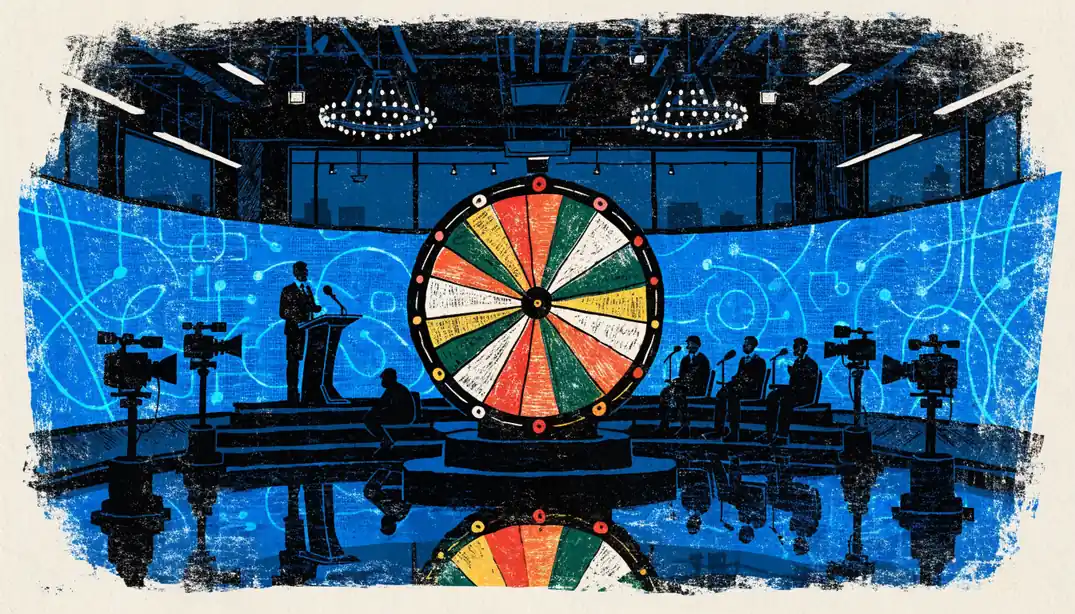
How Live Casino Game Shows Work Online
A live casino game show takes the familiar shape of a studio programme and puts a real-money game inside it. There is a presenter, a set, cameras, graphics and a sequence of decisions or outcomes that unfolds in front of you. You join through the casino’s website or mobile browser, watch the live feed and place your stake through the game interface.
That sounds close to a television quiz or contest, but the resemblance is only part of the appeal. This is still remote gambling. The studio atmosphere gives the session its personality; it does not change the fact that money is being risked on the result.
I used to treat the presenter as decoration. That was my first mistake. In a conventional table game, the dealer and the table are the centre of attention. In a show format, the host, the set and the rhythm of the broadcast are part of the product. You are not simply looking at cards or a wheel. You are watching an organised live production while the game round moves along.
What makes a game show “live”?
“Live” refers to the way the session is presented and conducted. A real studio feed is delivered to your screen, and the round follows the broadcast rather than being generated as a purely solitary animation on your device. Other people may be watching and playing at the same time, with the platform displaying the current round and the available controls.
 Slots & Providers: Casino Games and StudiosExplore UK casino pages for named slot providers, jackpot games, game shows and other categories, including options focused on craps and bingo.
 Best New Online Casino Sites in the UKLearn how new operators differ from new brands and games, and what to check in bonus terms, mobile play, slots and payment…
The exact production can differ from one title to another, so I would not assume that every live show uses the same equipment, sequence or style. The reliable general point is the combination of a streamed presentation and a game interface. You see the action, follow the host or dealer, and make a permitted selection before the relevant stage closes.
That creates a different feeling from a standard online casino game. A conventional digital game normally presents its rules and graphics on demand: you press a button, and the software produces the next result. There may be sound, animation and a themed interface, but there is no studio programme carrying the session from one round to the next.
A live show adds timing. The betting or decision window opens, remains available for a period, then closes as the round proceeds. The presenter may explain what is happening, keep the pace moving or react to the result. You have to follow the broadcast rather than stopping the action whenever you like.

That pace can be entertaining. It can also make a poor decision feel urgent. I have clicked into a round because the presenter was already moving on, not because I had decided that the wager made sense. “Interactive” can mean little more than a countdown with good lighting.
Live game shows compared with live dealer tables
The two formats share some features. Both can use a human presenter or dealer, a camera feed and a real-time interface. Both are commonly designed for remote play, so you watch events on screen while using the casino controls rather than sitting at a physical table.
The difference is the role of the presentation.
A conventional live dealer table is built around a recognised table game. The dealer deals cards, spins a wheel or manages the physical equipment associated with that game. The table layout, betting positions and established round structure do most of the work. The broadcast shows you the table and the person operating it.
 Best Online Casinos with No Limits: What to KnowLearn what “no limits” means for UK casino tables, slots and accounts, and where it has boundaries. Online slots have a £5…
 Best Barcrest Online Casinos UK: Amatic Slot GuideLearn how Amatic games reach UK casino lobbies, what to check before depositing, and why the supplier is not the casino operator.…
A live game show is more deliberately staged as a programme. It may use a brightly designed set, on-screen graphics, music, scripted links and a presenter-led sequence. The game is packaged as an event rather than shown as a quiet table session. The studio is not merely a camera pointed at a table; it is part of the experience.
That distinction does not tell you which format is better. It tells you what you are paying attention to. If you like the slower, familiar structure of a table game, a presenter-led show may feel noisy or rushed. If you want a more social and theatrical session, a standard table may seem flat.
The word “live” is therefore not enough to identify the product. Two games can both stream a person from a studio and still offer completely different experiences. Before staking anything, I look for the rules, the round sequence, the available outcomes and the way the platform explains the interface. The set can be impressive. It is not a substitute for that information.
The basic flow of an online show
Although formats vary, most live-show sessions can be understood as a repeating cycle:
- The next round is announced or introduced.
- The interface opens the available choices.
- You select a stake or outcome while the window is open.
- The betting period closes.
- The presenter or studio equipment carries out the round.
- The result appears on the screen.
- The platform settles winning and losing selections before the next round begins.
That outline is intentionally broad. It describes the shape of a live broadcast game without pretending that every title uses identical rules. The choices may be displayed as buttons, sections of a board, cards, symbols or other controls. The studio action may be simple or highly produced. The settlement information may appear beside the video or in a result history.
The important practical point is that the video and the controls work together. Watching the show does not place a wager by itself, and pressing a control does not give you unlimited time to change your mind. The interface indicates when selections are available and when the round has moved on.
I learned to watch one complete round before doing anything. That small habit catches details that promotional clips hide: whether the controls are easy to read on a phone, where the rules are opened, how the countdown is shown and whether the result history is clear. It also removes the pressure to join halfway through a sequence.

Why the studio presentation matters
A game show is designed to hold attention between decisions. The host fills the gaps, explains stages and gives the session a recognisable rhythm. Graphics can highlight choices or results. Music and camera changes make the next round feel like an event.
None of that alters the mathematical outcome of a wager. A dramatic reveal is still a reveal of the game’s result, not evidence that the next round is more likely to favour you. I have seen myself read atmosphere as information. It is not.
The presentation can, however, affect how quickly you play. A table game may give you time to examine a familiar layout. A show can move from introduction to decision to result with very little empty space. The constant motion is part of the entertainment, but it can also encourage repeated stakes without a pause.
I now separate the two questions:
- Do I understand what the available selections mean?
- Do I want to risk money on one of them?
A presenter answering the first question does not answer the second. A lively set answers neither.
Watching is not the same as playing
Online casino game shows often make it possible to observe the broadcast before making a choice. That is useful because you can learn the basic sequence and see how the interface behaves. You can also follow a round without placing a stake at all, where the platform allows that.
Watching previous results does not create a reliable prediction for the next one. A run of similar outcomes is still a record of what has happened, not a promise about what comes next. The host’s tone, the speed of the round and the reactions in the studio are presentation features, not betting signals.
This is where the television comparison can mislead. When you watch a quiz show, you may try to guess the answer and feel clever when you are right. In a casino show, your personal guess is only relevant if it corresponds to an available wager and the game settles it as a winning selection. Enjoying the suspense is separate from having an advantage.
DO
- Observe a complete round before placing a bet
- Check if controls are easy to read on your device
- Verify how the countdown and rules are displayed
DON'T
- Join a round halfway through a sequence
- Rely on promotional clips for game details
- Act impulsively due to the pace of the broadcast
I prefer to decide in advance whether I am there to watch, to play, or to do a little of both. Without that boundary, “just watching” can turn into an unplanned deposit decision, and “one round” can become a long session.
The online interface is part of the game
A physical studio has staff who handle the equipment and guide the audience. Online, the platform has to translate that experience into controls that work on your screen. You may see the video in one panel and the betting area in another, with account information and the round timer nearby.
On a desktop display, those elements may be easy to view together. On a phone, the video and controls can compete for space. A small screen can make it harder to read a rule, distinguish selections or notice when the betting window has closed. A fast connection may help the stream load smoothly, but it does not make unclear rules clearer.
I check the following before treating a session as playable:
- where the complete rules are located;
- how the available selections and their settlement terms are displayed;
- how the platform marks the opening and closing of a round;
- whether the current result and earlier results are distinguishable;
- how a submitted stake is confirmed;
- what happens if the video freezes or the connection drops.
These are not glamorous checks. They are the things I wish I had checked before trying to follow a broadcast with one hand on a phone and the other looking for the relevant button.
A show may also offer different viewing layouts, such as a larger video or a more prominent game panel. That can change how comfortable the session feels, but it does not change the underlying rules. I treat layout as a usability issue rather than a reason to assume better results.
How rounds create pressure
The repeated structure of a live game show can make time feel compressed. A new round starts, the host introduces it, the controls appear and the countdown begins. If you are undecided, the broadcast keeps moving. When the result arrives, another opportunity may follow quickly.
That is different from many conventional casino games, where you can often leave the screen after a result and return when ready. The live format encourages continuity. The next round is already part of the programme.

My own weak point has always been the phrase “while I’m here”. It sounds harmless, but it turns the length of the broadcast into a reason to continue. The show does not know whether I am enjoying myself or chasing a loss. It simply presents the next round.
A practical pause helps. I close the game after a planned session rather than waiting for the broadcast to provide a natural ending. Game shows are built to avoid dead air; that is good television and poor support for an impulsive exit.
Stakes, results and entertainment value
The central transaction remains straightforward: you choose an available wager, the round produces a result and the casino account is settled according to the published rules. The presenter and production may make that sequence feel more social, but the financial outcome still matters.
That is why I avoid describing a show as “free entertainment” merely because the stream is engaging. If real-money play is available and I use it, I am gambling. A colourful set does not make a losing stake disappear, and a cash result does not prove that the format is generous.
The entertainment value can be real. Watching the host manage the pace or seeing a studio outcome develop may be more enjoyable than pressing a button on a silent digital game. But entertainment and value for money are not identical. I can enjoy a session and still decide that the cost was not worth repeating.
The same applies to claims such as “best” or “top”. There is no universal best live show for every player. One person may care about presentation, another about the clarity of the rules, another about how well the controls work on a mobile screen. Since named titles and their current availability can change, I would judge the format first and the individual listing separately.
What a live show does not guarantee
A live camera feed does not guarantee a fairer result. A human presenter does not guarantee a better return. A large audience does not turn a wager into a group decision. The word “live” describes delivery and timing; it is not a quality mark by itself.
Likewise, a game show is not automatically easier to understand than a conventional table. The host may explain the flow, but you still need to read the rules and understand what each selection means. If the presentation is fast or the graphics are crowded, the extra production can make the actual decision less obvious.

I have become suspicious of any description that uses “immersive” as if it were a financial feature. Usually it means the screen is busy and the session is good at holding attention. That may be exactly what you want from entertainment. It is not a reason to increase a stake.
A sensible first look
If you are trying live casino game shows online for the first time, I would begin with observation rather than a deposit decision. Open the information panel, watch the rhythm of a round and identify the point at which choices close. Check whether the game explains its outcomes in plain language. Then decide whether the format suits the way you prefer to play.
The useful comparison is not “show versus table” in the abstract. It is:
- presenter-led production or quieter dealer-led play;
- rapid recurring rounds or a pace you control more easily;
- entertainment and studio atmosphere or a simple game layout;
- a format you can follow clearly on your chosen screen or one that feels crowded.
Once you know which side of that comparison you prefer, the label matters less. A live game show is a broadcast wrapped around a casino game. It can be sociable, polished and fun to watch. It can also make repeated decisions feel effortless.
That last part is the one I keep in view. The host moves on; I do not have to.
Finding Live Game Shows at UK Online Casinos
Finding a live game show at a UK casino is less straightforward than typing a title into a lobby search and assuming the result settles everything. The game has to reach the operator through a distribution route, the operator has to make it available to its customers, and the page you are viewing has to describe the current catalogue accurately.
That chain matters. I have clicked through casino menus where a provider appeared in an old review but not in the operator’s own lobby. The name looked reassuring. The game was nowhere to be found.
How titles reach a casino lobby
A game supplier does not normally open a consumer account for you. Its role is to create and supply gaming content to licensed operators. The casino then places that content inside its own website or app, manages your account, and deals with the money side of your play.
For Amatic, the route into a British casino can be a direct technical integration or an aggregator feed. In practical terms, that means the operator may connect to the supplier itself, or receive access through a distribution platform that brings together content from several providers.

You therefore do not visit Amatic to open a playing account. Amatic does not accept bets from British players directly. The operator is the business responsible for deposits, withdrawals, bonus conditions and customer support.
That distinction is easy to lose when a casino page uses provider logos heavily. A supplier logo tells you where content comes from. It does not tell you who holds your balance or who must answer when a withdrawal is delayed.
A provider name is not a licence check
The appearance of a game or provider in a casino lobby is an editorial and commercial listing. It is not an entry in the Gambling Commission register.
Any UKGC-licensed operator may use a business-to-business arrangement involving Amatic. That permission concerns the supply relationship; it does not turn every casino mentioning Amatic into a licence holder. The operator still needs its own UKGC licence to offer remote gambling to British customers.
I keep these checks separate:
- Who supplies the title? This identifies the game provider or distribution route.
- Who operates the casino account? This is the company taking deposits and paying winnings.
- Does that operator hold a current UKGC licence? This is checked against the Gambling Commission Public Register, not inferred from a provider logo.
- Is the title actually available now? The operator’s current lobby or provider list is the useful confirmation.
A polished page can answer the first question while leaving the other three unclear. That is where the trouble starts.
Check the operator before depositing
When I compare online casinos offering live game-show content, I start with the operator rather than with a list of attractive titles. The first deposit is the point at which the casino’s identity, terms and account controls become your problem, so I do the boring checks first.
Look for the operator’s legal details and UKGC information on its website. Then compare the licence details with the Gambling Commission Public Register. Do not treat a review page, a search result or a banner as a substitute for that check.
The casino should also explain who handles:
- account verification;
- deposits and withdrawals;
- bonus terms;
- complaints;
- responsible-gambling tools;
- customer support.
This is not bureaucracy for its own sake. If the supplier does not accept your bet or hold your funds, contacting the supplier will not resolve an operator dispute. Your account relationship is with the casino.
Confirm the show category in the current lobby
A casino may place live content under several menu labels. One operator might use a dedicated live section; another might group games by studio, supplier or format. The same title can be easier to find through the provider filter than through a broad “live casino” page.
I would check the following places:
- the live casino lobby;
- the game-show or entertainment category;
- the provider filter;
- the operator’s current game directory;
- the title’s own information page.
The wording on an affiliate review can lag behind the live lobby. A specialist review can be useful for discovering that a provider has appeared at a particular operator, but it is not proof that the title remains there today. Availability changes, and a review that was accurate when published can become a catalogue fossil.
That is why the operator’s own current provider list deserves the final word before you deposit. The list should show whether the relevant provider or title is included for your account and jurisdiction. If it does not, customer support can confirm availability before any money is added.
A quick message is better than a guess. Very glamorous, I know.
Distribution does not guarantee identical access
Aggregator feeds make it possible for operators to receive content from the same supplier without presenting identical lobbies. Each casino decides how its catalogue is organised and which products it makes visible.
Differences can arise in:
- the provider filters shown to customers;
- the categories used by the lobby;
- whether a title is available on desktop, mobile or both;
- whether the game is open to every customer or subject to account or jurisdiction settings;
- how the operator presents the title’s rules and terms.
The important point is not to assume that one casino’s listing proves another casino carries the same content. A direct integration at one operator does not establish availability elsewhere, and an aggregator relationship does not mean every title in a supplier’s catalogue is activated for every operator.
I have made that assumption myself: saw a provider listed at one site, then searched for the same catalogue at another and expected the result to be automatic. It was not.
What to check on the game page
Once you find a show-style title in the lobby, open its information panel before playing. The page should identify the operator and provide access to the relevant game rules. Pay attention to the version actually displayed, rather than relying on a general provider description copied across several sites.
The useful checks are practical:
- Is the title available for real-money play from your account?
- Does the game load through the operator’s own platform?
- Are the rules and settlement conditions visible?
- Does the page identify the provider or studio?
- Are the applicable bonus terms clear if you intend to use promotional funds?
- Can you locate support without leaving the operator’s site?
Do not confuse a free-play preview with confirmation that the real-money version is available. A demo can remain visible after a title has been removed from the cash lobby, or it can show a general product that is not enabled for your account.
The deposit page also matters. The operator, not the supplier, controls the payment relationship and must explain its deposit and withdrawal process. A provider page cannot replace those details.
Do not use offshore listings as a shortcut
Some websites outside the UK regulatory framework advertise supplier content to British visitors. Offshore casinos do not hold a UKGC licence, so their presence in a directory does not make them UK online casinos.
I would not use an offshore listing to fill a gap in the British lobby. It may show a title that is not available through a UKGC-licensed operator, but it does not provide the UK regulatory framework that applies to licensed remote gambling in Great Britain. It also does not give you the same UKGC complaints and redress route.
The casino being accessible from Britain is not the same as it being a licensed British operator. Those are separate things.
A sensible comparison method
If several UKGC-licensed casinos appear to offer live game-show content, I compare them in a fixed order rather than chasing the largest-looking catalogue.
| Check | What it tells you |
|---|---|
| UKGC Public Register | Whether the operator has the relevant current licence |
| Operator’s own provider list | Whether the supplier is currently carried |
| Live lobby and title page | Whether the game is actually visible and playable |
| Terms and rules | How the operator presents play, bonuses and settlement |
| Support contact | Whether the casino can confirm availability before deposit |
| Account controls | Whether the operator gives you the required tools before play |
This approach avoids calling a casino “best” merely because an old page lists more names. A bigger catalogue is not useful if the title has disappeared, the operator details are unclear or the listing came from an unlicensed site.
The phrase “best live game shows casinos” sounds like a ranking request, but a responsible comparison needs current operator evidence first. Without that, the ranking is decoration.
What to do when a title is missing
If you cannot find a named show, do not assume the casino has hidden it under another label indefinitely. Try the provider filter, check the operator’s current directory and ask support whether the title is available to British customers.
A negative result can mean several things: the operator does not carry the provider, the title has been withdrawn, the lobby uses a different category, or the game is not enabled for your account. The operator is the only party positioned to confirm which explanation applies.
Keep a record of the answer if it affects your deposit decision. A chat response or support email can be useful when the public lobby is vague. I would still check the actual game page after the reply, because catalogue pages and support scripts do not always change together.
Before the first deposit
My checklist for an online casino with live game shows is deliberately plain:
- confirm the operator’s identity;
- check its UKGC licence in the Public Register;
- find the current provider or game list;
- open the title page rather than relying on a banner;
- read the relevant rules and promotional terms;
- verify that support can confirm availability;
- deposit only after the account and game route make sense.
Amatic content reaches UK operators through direct integration or aggregator distribution, not as a standalone consumer product. The supplier provides the games; the casino provides the account relationship. Once that division is clear, the search becomes less about trusting a promising logo and more about checking the actual operator, its current lobby and its licence.
That is the useful distinction.
Crazy Time and Funky Time: What Can Be Verified
Crazy Time and Funky Time are names many UK players associate with the live casino game-show category. They are also easy to overstate. A title appearing in a search result, a casino menu or an affiliate article does not by itself establish who supplies it, which operator offers it, how it is played, or whether it is currently available to British customers.
That distinction matters when real money is involved. I have learned the awkward way that a confident description can be copied from one page to another until it sounds like a settled fact. It may still be wrong, outdated or referring to a different product.
Crazy Time
So it would be careless to attach specific mechanics to the title without checking the current game information supplied by the operator hosting it. The same applies to claims about bonus rounds, wheel sections, multipliers, presenters, minimum stakes, maximum stakes or mobile performance. None of those details should be treated as confirmed merely because they appear in a description elsewhere.
The practical check is simple: open the title inside the casino’s own lobby and read the displayed information before depositing. Look for the provider name, the game rules, the applicable stake controls and the terms governing any promotional balance. The operator is the party dealing with your account, deposits, withdrawals, support and bonus conditions. A game name alone tells you none of that.
Calling it a “top pick” would be advertising language, not evidence.
Funky Time
Funky Time raises the same problem.
That means descriptions should stay tied to what the particular casino displays. If a lobby shows the game, check that the site is serving British customers under a current UKGC licence and that the title is available for your account rather than merely shown in a general catalogue. Availability can change, and an old review is not a live inventory record.
I would also avoid treating a similarly named title as interchangeable with Funky Time. Casino pages often group products by category, provider or promotional campaign. Grouping does not prove that two games share rules, odds, features or even the same supplier. Read the information attached to the exact title.
What a responsible comparison can say
A proper comparison would need current, title-specific information such as:
- the confirmed game provider;
- the operator offering the title to UK players;
- the rules and betting options shown in the live game;
- the published return or payout information, where supplied;
- the minimum and maximum permitted stakes;
- the terms for any bonus or promotional feature;
- the date on which availability was checked.
“Exclusive” can simply mean the page is promoting it. “Hot” can simply mean the banner is large.
Before you play either title
Treat the game name as a starting point, not as proof of a product’s current status. The casino account is the relevant place to check the title, its rules and the conditions attached to play. Confirm that the operator is licensed for the British market, use the account controls offered before depositing, and read the game and bonus terms rather than relying on a short promotional label.
If the title is unavailable after login, that is not something a third-party page can fix. If the rules shown by the operator differ from an older review, the current operator information is the one that matters for the session in front of you.
Named games deserve named evidence. Anything else is guesswork.
Live Casino Game Shows: UK Rules That Affect Play
When you play a live casino game show for real money in Great Britain, the important legal relationship is between you and the operator accepting the bet. The UK Gambling Commission regulates commercial gambling in Great Britain and covers remote gambling even when the operator’s equipment is located elsewhere. It is the country’s sole commercial gambling regulator.

That makes the operator’s status more important than the branding of the show. A business offering remote gambling to British customers needs the appropriate UKGC licence. The Commission grants operating licences to gambling businesses and personal licences to individuals working in relevant roles. A provider, presenter or game name does not replace the operator’s responsibility for deposits, withdrawals, account controls and customer protection.
The stake cap depends on the game type
The statutory stake limits listed here apply to online slots, not automatically to every live casino product. That distinction matters because a live game show may be presented through a casino lobby without being an online slot. Do not assume that a slot rule transfers unchanged to a live table or another product category.
For online slots, the maximum stake per game cycle is:
- £5 for players aged 25 and over, with the rule taking effect on 9 April 2025;
- £2 for players aged 18 to 24, with that lower limit beginning on 21 May 2025.
Your age therefore affects the permitted slot stake. It does not give the operator discretion to ignore the applicable ceiling. If a product is described as a slot, the relevant limit should be applied according to your age group. If it is a different casino game, check its classification and terms rather than guessing from the interface.
I have made that mistake before: treating a bright game lobby as if every product followed the same rule. It does not.
Bonus terms have a hard boundary
Promotional money can change how a session works. The UKGC’s wagering cap limits bonus-fund playthrough requirements to 10×, a rule that came into force on 19 December 2025. In practical terms, a qualifying bonus cannot be surrounded by a wagering condition above that ceiling.
That does not mean every offer has identical conditions. You still need to read the promotion’s eligibility rules, expiry wording, game contribution terms and withdrawal restrictions. The cap concerns the wagering requirement attached to bonus funds; it is not a promise that every bonus is withdrawable immediately or that every stake contributes in the same way.
For a live game show, pay particular attention to whether the promotion permits that product at all. A casino may advertise a general welcome offer while excluding live casino games, or it may apply separate contribution rules. “Casino bonus” is not the same as “usable on every casino game”.
Account limits come before the first deposit
UKGC-licensed operators must ask customers to set a financial limit before accepting the first deposit. This is an account-control step, not a decorative message to click past. If you lower the limit later, the reduction must be applied immediately.
The practical point is simple: set a figure you can live with before money enters the account. A live broadcast can make decisions feel quicker than they are, particularly when the next round is already visible. A limit set in advance removes some of the pressure to keep deciding in the moment.
The operator remains responsible for providing the control, but you are responsible for choosing a limit that reflects your own circumstances. A limit is not a spending target and should not be treated as permission to reach it.
- Confirm the operator's identity
- Check the UKGC licence in the Public Register
- Find the current provider or game list
- Verify support can confirm availability
- Set a financial limit before your first deposit
GamStop and self-exclusion
GamStop applies to all online operators licensed for Great Britain. Its mandatory status for those operators has been in place since 31 March 2020. Once you are registered, participating operators must prevent you from using their covered remote gambling services during the exclusion period.
This protection operates at the operator level rather than being tied to one presenter, studio or game title. Moving from one branded live game show to another does not bypass a valid GamStop exclusion when both are offered by participating GB-licensed operators.
If you want a break without using a formal exclusion, an operator may also provide its own account tools, such as deposit or session controls. Those tools are separate from GamStop and should not be confused with it. If you have decided to stop gambling altogether, attempting to manage access by opening another account is the wrong direction.
What to check before playing
Before depositing with a live game show casino, I would check four things:
- The operator’s UKGC licence status. The operator taking your money must hold the relevant licence for serving customers in Great Britain.
- The product classification. The £5 and £2 limits specified above concern online slots, so identify whether the selected game is actually a slot.
- The promotion’s wording. Look for the wagering requirement, eligible products and withdrawal conditions; the bonus-fund requirement cannot exceed 10×.
- The account controls. Set the financial limit before the first deposit and remember that any reduction should take effect immediately.
Those checks do not make a session risk-free. They tell you which safeguards should be present and which terms control the money you are about to use. That is the useful part of regulation: not a badge on the homepage, but rules you can test against the account in front of you.
Are Amatic games licensed and legal to play in the UK?
Yes. Amatic Industries holds a UK Gambling Software licence, and its games are supplied to UK players through UKGC-licensed casino operators.
What is the new UK slots stake limit and how does it affect Amatic games?
The limit is £5 per game cycle for players aged 25 and over, and £2 for those aged 18 to 24. It applies to Amatic online slots offered by UK-licensed casinos.
Are Amatic casinos safe and regulated in the UK?
Amatic is a software supplier, not a consumer-facing casino. For UK play, choose a UKGC-licensed operator, which is responsible for your deposits, payouts, bonus terms and customer support.
Does Amatic offer live dealer games?
Amatic is described as a software supplier whose games are distributed through UK-licensed operators. The available information does not establish that it offers live dealer games.
Created by the ”Casino not on Gamstop” editorial team.