Progressive slots pool contributions from qualifying wagers, but triggers, game rules and availability shape what a displayed prize really means.
 Available in GB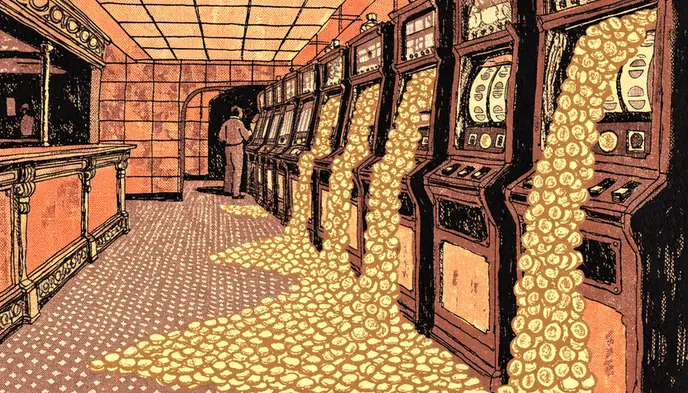
Table of Contents
- How Progressive Jackpots Build Up—and What the Game Gives Up
- Online Play: Free Spins, Qualification Rules and Changing Game Menus
- Choosing a UK Casino Without Trusting the Jackpot Banner
- Slot Machines, Network Pools and Where the Jackpot Comes From
- Progressive Slot Games: Triggers Matter More Than the Label
- Why the Biggest Progressive Jackpot Is Not a Useful Ranking on Its Own
- What “Popular” Progressive Slots Can—and Can’t—Tell You
- Mega Moolah: Check Availability Before You Chase the Name
- Real-Money Play and the Wait After a Big Win
How Progressive Jackpots Build Up—and What the Game Gives Up
A progressive jackpot is not a prize sitting inside one isolated slot cabinet. It is a pool that grows as qualifying wagers are made. Each spin contributes a small part of the stake to that pool, while the rest supports the ordinary game: symbols, features and its regular pay table.
That is the basic reason the displayed prize can keep climbing. More play means more contributions. If the same progressive slot is connected across several machines, the wagers made on those machines can feed the same pool rather than separate local prizes. One machine may show the amount, but the money building it can be coming from players elsewhere in the network.
It sounds more dramatic than it feels when you are watching the reels. My first mistake was treating the rising figure as if it were a reward attached to every spin. It is not. A spin gives you a chance to win according to the game’s rules; the progressive element is an additional prize mechanism funded from play.
Where the jackpot contribution comes from
The contribution is taken from the wager rather than added by magic. Progressive jackpot slots typically direct between 1% and 3% of each wager into the jackpot pool. The exact arrangement belongs to the game and its network, so the amount shown on the screen should not be read as a direct measure of what any single player has put in.
Imagine connected machines carrying the same title in different places. A player on one machine makes a wager, and another player elsewhere does the same. Their contributions can accumulate in one shared total. That is why a progressive jackpot casino slot can display a prize much larger than the recent activity at the particular casino or machine you are using.
The word “shared” matters. It does not mean every slot in the building, or every slot on the internet, pays into one universal pot. The connection is set by the game and its provider or network. Machines carrying different games can have completely separate pools, even if they are next to each other or offered by the same casino.

The same principle applies when the game is offered online. Online progressive jackpot slots may be linked through the provider’s network, allowing wagers on connected versions of the title to feed the relevant pool. The game’s presence on a website does not, by itself, tell you which other machines or operators are connected to it.
The trade-off inside the game
Funding the jackpot has to come from somewhere. A progressive slot can allocate part of its return to the growing prize, leaving a lower expected return in the base game. For progressive slots, the base-game RTP often falls in the 88%–92% range, with the difference directed towards the jackpot pool.
RTP means the theoretical amount a game returns over a very large number of plays, not what you should expect from one session. It also does not tell you when the progressive prize will land. A slot can have a large headline jackpot and still give you a run of ordinary spins with no meaningful win. The base-game figure and the jackpot opportunity are related, but they are not the same thing.
This is the part advertising tends to blur. “Bigger potential” sounds like a free upgrade. It is not. The game is designed with a portion of its payout allocation reserved for the progressive prize. In return, you get access to a jackpot that can grow beyond what a fixed prize on the same style of slot might offer. Whether that exchange suits you depends on what you are actually looking for.
If I want longer, steadier entertainment from the ordinary features, I pay attention to the base game rather than staring at the jackpot meter. If I am specifically interested in the chance of a very large prize, I accept that the regular game may return less generously in theory. Neither choice makes the slot “best” in every situation.
Why one jackpot can keep growing
A progressive prize rises when contributions enter the pool faster than the prize is won. Connected slot machines make that possible because activity is combined across the network. A quiet machine can therefore show a substantial jackpot if the same game is active in many other locations.
When the progressive prize is awarded, the pool is reduced or reset according to the game’s design, and later wagers begin building it again. The displayed total is consequently a moving balance, not a promise that the next player will receive it. Watching the number increase can be entertaining, but it does not change the underlying odds of a particular spin.
That also explains why comparing progressive slots by the size of their meters is a weak shortcut. A larger figure may reflect a wider network, longer accumulation or simply more recent activity. It says nothing on its own about the base-game return, the way the jackpot is awarded or how often a player will see a winning result.
So when you look at slots with a progressive jackpot, separate the two things in your head: the everyday game and the pooled prize. The first is funded through the game’s normal return structure. The second grows from contributions made across connected play. The jackpot is real, but it is not free.
A tempting extra, with a cost.
Online Play: Free Spins, Qualification Rules and Changing Game Menus
Trying a progressive jackpot slot for free sounds like the sensible first step. I have done that myself, mainly to see whether the game felt worth opening with cash behind it. The catch is that a free version can show you the reels and bonus features without giving you the same route to the progressive prize.
A demo mode is mainly a way to learn the interface. You can check the paytable, see how the bonus round behaves and decide whether the pace suits you. It does not, by itself, put you into a real jackpot pool or create a cash balance. That distinction matters when a banner makes the free version look almost identical to the real-money game.

Free spins are not a shortcut to the jackpot
Promotional free spins come with their own terms, and progressive games are often treated differently from ordinary slots. A specialist review of casino promotions reports that free-spin winnings from progressive slots are commonly capped at between £50 and £100, while most free-spin offers are limited to non-progressive games. That is a description of reported promotional conditions, not a rule that every operator follows.
So I check the offer before pressing the spin button. The important points are whether the named game is included, whether the spins can be used on a progressive title, and whether any winnings have a separate maximum. The promotion may advertise “free spins”, but the useful question is what those spins can actually produce.
No deposit offers need the same treatment. A specialist review of bonus terms reports wagering requirements of 40x to 60x for this type of offer, with maximum withdrawals on those winnings commonly set between £50 and £100. Those conditions can make a free attempt much less straightforward than a demo. You may not be risking a deposit, but you are still agreeing to rules before the resulting balance becomes withdrawable.
I prefer to read the terms before becoming attached to a jackpot counter. Less exciting. Much clearer.
Cash play can change the qualification
With real-money progressive jackpot slots, the trigger is part of the game’s rules, not just a marketing label. Some jackpots are awarded through a random event. Others depend on landing a specified combination or reaching a bonus round first. That means two games carrying the same progressive wording may ask you to reach the prize in completely different ways.
Random Trigger
The jackpot can land during ordinary play without a specific symbol pattern.
Combination Trigger
Requires landing a specific set of symbols or a defined reel result.
Bonus-round Trigger
Winning is tied to entering a specific feature or bonus round.
A random trigger does not necessarily mean every stake has access to every tier. A specialist review of progressive games reports that certain random-trigger titles require a minimum bet to qualify for their highest jackpot level. Because that condition belongs to the individual game, I would not assume that a small stake has the same jackpot eligibility as a larger one. The paytable and the game information should explain the qualifying bet.
For a combination-based jackpot, the relevant detail may be the symbols, paylines or bonus feature required. For a bonus-entry jackpot, you need to know what starts that feature and whether the progressive prize is awarded inside it. The word “progressive” tells you that the prize can grow; it does not tell you how to reach it.
British online play also has practical limits that affect how the session feels. Autoplay is not available for online slots, and each game cycle must last at least 2.5 seconds before another can begin. The maximum stake per cycle is £5 for customers aged 25 and over, and £2 for customers aged 18 to 24. Those are not optional settings a casino can quietly remove. They apply to online slots offered in Britain.
Why the same title is missing elsewhere
I have opened one casino expecting to find a familiar progressive slot and then failed to locate it anywhere in the lobby. That does not necessarily mean the game has disappeared. Game availability varies between operators and can change when providers update their catalogues; this point is also reported in a specialist review of casino game menus.

The reasons are practical. An operator may not carry a particular provider, may have removed a title during a catalogue change, or may show progressive games in a separate category rather than under the general slot filter. A game can therefore be available at one UK casino and absent from another without either lobby being broken.
Searching by the exact title is useful, but I also check the provider filter, the jackpot category and the game’s information panel. If the title still does not appear, I treat that as a catalogue issue rather than a promise that it will become available after registration.
That is especially important with an online progressive jackpot slot promoted on a landing page. Promotional pages can remain visible while the lobby changes. Before depositing, I would confirm that the game opens, that the real-money version is available, and that its qualifying conditions are displayed.
Before switching from free to cash
My short checklist is simple:
- use demo play to inspect the game, not to assume jackpot eligibility;
- read the free-spin terms for game restrictions and the stated winnings cap;
- check whether the jackpot is random, combination-based or linked to a bonus round;
- confirm any minimum bet attached to a higher jackpot tier;
- search the live lobby rather than relying on an old promotional page.
That separates free online progressive jackpot slots from real-money progressive jackpot slots without pretending they are interchangeable. The free version can help you decide whether you like the game. The cash version is governed by its own trigger, stake and promotional conditions. Different decision. Different risk.
Choosing a UK Casino Without Trusting the Jackpot Banner
A large figure beside a progressive slot can make a casino look impressive. I used to treat that banner as a shortcut: if the prize was visible, the site must have been worth my time. That was a poor test. The banner tells you about the promotion being shown; it does not tell you who operates the site, which regulator oversees it, or what control you have after opening an account.
For a progressive jackpot casino, I now start with the operator rather than the game. That means checking the legal position, account protections, payment rules and complaints route before looking at the lobby. The game can still matter, but it comes later.
Do
- Check the UKGC licence on the public register
- Verify the specific jackpot trigger rules
- Use demo play to learn the game interface
Don't
- Trust a jackpot banner as a sign of operator reliability
- Assume a large jackpot means a better base-game return
- Rely on promotional pages for current game availability
Confirm the UK Gambling Commission licence
The UK Gambling Commission regulates commercial gambling in Great Britain, including online casinos. It is the sole regulator for commercial gambling there. Remote gambling offered to consumers in Great Britain falls within that system even when important equipment or company operations are located elsewhere.
That makes the licence more than a logo in a footer. A casino site serving British customers should identify its operating company and UK Gambling Commission licence. Check those details against the Commission’s public register before depositing. Do not rely on a badge, a review page or a sentence saying that the casino is “trusted”. The register is the useful check.
The Commission issues operating licences to businesses and personal licences to individuals involved in operating gambling businesses. For you as a customer, the business’s operating licence is the central point. If the site gives you no clear operator identity or licence information, I would stop there rather than trying to work it out from a jackpot advert.
This also applies when the wording is dressed up as a special category: a “best progressive jackpot casino”, a casino site focused on slots, or a platform promoting a large online prize. The label changes nothing. If it accepts real-money play from British customers, the relevant UK licensing position still matters.
Do not confuse visibility with protection
A progressive jackpot casino may put its prize total on the home page, repeat it in banners and use urgent language around a bonus. None of that replaces the protections attached to a UK Gambling Commission licence.
UK-licensed operators must provide responsible gambling tools. These include:
- deposit limits;
- loss limits;
- session reminders;
- self-exclusion;
- access to gambling support resources.
I prefer to find these controls before registering, not after I have already deposited. A decent account page should make the limits understandable and accessible. If the site hides them behind several menus, that is worth noticing even if the progressive slot lobby looks polished.
Remote operators must also prompt new customers to set a financial limit before the first deposit and provide account-level controls for changing limits. That gives you a practical pause before money enters the account. I have skipped that pause in the past, then spent the rest of the evening managing a decision I should have made earlier.
The point is not that a limit makes gambling harmless. It gives you a boundary you can set before the excitement of a jackpot display starts doing the persuading.
Check the account rules before the bonus
Searches for a progressive jackpot casino bonus often lead to a large welcome offer. The important information is normally in the terms, not the headline. Read what happens to the bonus, the deposit, the eligible games and any withdrawal request.
Some promotional terms can make free-play winnings from progressive slots unavailable or subject to a cap. A specialist review has reported that free-spin winnings from progressive slots may be capped at £50–£100 and that many free spins are limited to non-progressive games. Treat that as a term to verify in the individual offer, not as a universal rule for every UKGC-licensed casino. The casino’s own bonus conditions are the controlling document.
Promotional winnings caps
Many free-spin promotions on progressive slots have specific limits. Specialist reviews report that winnings may be capped between £50 and £100, and some offers might only apply to non-progressive games.
The same caution applies to no-deposit offers. A specialist review has described wagering requirements of 40x–60x and maximum withdrawal caps of £50–£100 for such winnings. Those conditions are not a reason to assume every offer works that way, but they show why “free” is not the same as unrestricted. If the terms are vague about eligible games, wagering, expiry or withdrawals, I would not deposit simply to unlock the banner.
A progressive jackpot casino bonus may exclude the very slot that attracted you. It may also require a separate qualification step or restrict the funds to selected games. Those are operator terms, not features you can infer from the jackpot amount.
Watch the payment options
Payment branding can create another false sense of choice. UK-licensed casinos cannot accept credit cards for gambling. That includes credit-card funding routed through a money service business. Operators also cannot accept wallet payments where the wallet permits credit-card funds to be used for gambling.
So if a progressive jackpot casino site prominently promotes a payment route, check how it is funded and whether the method is actually available to you under the UK rules. A payment icon is not proof that every route shown can be used for gambling.

The same applies to bitcoin progressive jackpot casinos and crypto-focused sites. A casino mentioning Bitcoin or other cryptocurrency is not automatically outside British regulation, nor is it automatically inside it. The question remains whether the operator serving you holds the relevant UK Gambling Commission licence. Do not let a crypto payment option distract you from that check.
I would also read the casino’s withdrawal conditions before making a deposit. The operator should explain identity checks, available payment methods and any restrictions that can affect receiving winnings. That is basic account information, but it matters more than a moving jackpot counter.
Look for complaints and outside support
A UKGC-licensed casino must provide an internal complaints process and access to an approved Alternative Dispute Resolution service. Find both before playing. If the site only offers a generic contact form and vague promises about resolving issues, I would treat that as unfinished homework.
The licence check and complaints route work together. The first tells you whether the operator belongs in the UK regulatory framework; the second tells you what route exists if communication with the casino breaks down. Neither guarantees that every dispute ends the way you want, but both are more useful than a five-star claim beside a slot thumbnail.
Responsible gambling support should also be visible. UK-licensed operators are required to provide access to support resources, and services such as GamCare, Gamblers Anonymous and BeGambleAware are separate places to seek help. GAMSTOP provides a self-exclusion route for eligible online gambling accounts. I would rather know these options while everything feels controlled than search for them during a bad session.
Make the operator pass a short check
Before depositing at a site offering progressive jackpot slots, I use this order:
- Identify the business operating the casino.
- Check its UK Gambling Commission operating licence on the public register.
- Confirm that the account offers deposit limits, loss limits, session reminders and self-exclusion.
- Look for the first-deposit financial-limit prompt and accessible account controls.
- Read the bonus terms, especially game eligibility and withdrawal conditions.
- Check the payment rules, including the prohibition on credit-card gambling.
- Find the complaints procedure and approved ADR details.
- Only then inspect the progressive slot catalogue and any advertised bonus.
This process works whether the site calls itself a progressive jackpot casino, presents a selection of progressive jackpot casino sites UK players can access, or markets itself as a crypto-friendly alternative. The wording may change. The checks do not.
I am not saying the banner is meaningless. It can point you towards a game you want to investigate. It can show that the casino carries a particular provider’s title. It can even be the reason you found the site. But it should never be the reason you trust the operator.
The jackpot is the shop window. Check the building.
Slot Machines, Network Pools and Where the Jackpot Comes From
A progressive jackpot slot is easier to understand when you stop viewing it as a lone cabinet or isolated game tile. The visible reels may be running on one machine, but the prize meter can belong to a wider system connecting many machines that carry the same title.
Each qualifying wager made on those connected slot machines sends a contribution into the progressive pool. The amount is linked to play across the network, not just to the person currently sitting at one terminal. That is why a jackpot can keep rising even when your own session has been short: other players may be using the same game elsewhere.
One machine, many contributors.
How the machine connects to the pool
In a physical casino, the connection is handled through the casino’s gaming system and the provider’s network. A bank of progressive slot machines may display the same jackpot value, with the central system updating the figure as wagers are recorded. The machine supplies the reels and the player interface; the network keeps track of the shared prize.

The same basic idea can appear online. A progressive slot may be hosted by several UKGC-licensed operators while remaining connected to a provider-managed jackpot network. Players do not need to be visiting the same website for their wagers to feed the same pool. The important link is the shared game and its network arrangement.
That does not mean every progressive slot machine belongs to one universal jackpot. A game can have its own pool, a pool limited to a particular group of machines, or a network covering several operators. The title and the provider’s setup determine which machines and casino platforms are connected.
Why the operator’s site is not the whole picture
When you open a progressive game at a casino site, the screen can make the jackpot look like part of that casino’s own promotion. In networked play, that impression can be misleading. The operator may provide access to the game, but the accumulating prize can be shared with other operators carrying the same progressive slot.
This is also why two websites can show the same game while offering access to the same network jackpot. The casino is not necessarily running a separate prize fund beside the other sites. It may be connected to the provider’s wider system, with wagers from participating players feeding the shared amount.
I used to read the number above the reels as if it belonged to the particular room I was playing in. It may not. The network is the bigger room.
What to check on a progressive machine
The useful detail is not just the word “progressive” in the game title. Look for the jackpot display, the game information panel and the rules explaining the network or pool. Those details can indicate whether the prize is linked to other machines and whether the displayed amount is shared across participating casino sites.
For progressive jackpot machines in the UK, availability still depends on the operator carrying the title and its current catalogue. A game appearing in one casino’s lobby does not establish that every other site offers it, or that every machine using a similar name is connected to the same pool.
So when comparing progressive casino sites, treat the machine as one access point rather than the entire jackpot system. The prize may be built by wagers made across a much broader network of connected play.
Progressive Slot Games: Triggers Matter More Than the Label
The word “progressive” tells you that a jackpot can grow, but it does not tell you how the game awards it. That trigger is the part I check first. Two progressive jackpot games may look similar in the lobby while asking you to reach the prize in completely different ways.

Random jackpot triggers
Some games use a random trigger. The jackpot can land during ordinary play rather than requiring a particular symbol pattern on the reels. That makes the result difficult to read from the visible spin: a near miss may mean nothing, and a routine-looking round may be the winning one.
This does not mean every bet has identical access to every prize tier. A specialist review has reported that certain random-trigger progressive games require a minimum stake to qualify for the highest jackpot level. I treat that as a game-specific condition to verify in the rules, not as a blanket rule for all progressive jackpot slot games. The paytable, help screen or operator’s game information should settle the point before you play.
A specified combination
Other progressive jackpot slot games attach the prize to a defined combination. You may need particular symbols, a set of matching icons or a stated reel result. Here, the trigger is at least visible in principle: the rules describe what must appear, even though the chance of producing it remains uncertain.
That distinction matters when someone calls a title one of the “top progressive jackpot games”. A large advertised prize does not explain whether the jackpot comes from a random event or a precise combination. Nor does the label tell you whether the qualifying result sits in the base game or depends on a separate feature.
- Confirm the game is the actual title and not a category
- Check if a minimum bet is required for the top jackpot
- Verify the jackpot trigger type (random, combination, or bonus)
- Review the withdrawal timeframes for your chosen method
Bonus-round entry
A third route is entry into a bonus round. The progressive award may be decided after the main reels send you into a feature, rather than being paid directly from the ordinary result. The bonus screen may then determine the prize through its own choice, reveal or selection mechanic.
I have made the mistake of seeing a growing figure and assuming the important detail was the amount. It was not. The trigger changed how I understood the game: random awards are not read like reel combinations, and bonus-entry games need their feature rules checked separately.
So when comparing progressive jackpot casino games in the UK, start with the trigger description, not a “biggest” or “popular” badge. Check whether the jackpot is random, tied to a specified combination, or reached through a bonus round. Then look for any stated minimum-bet condition attached to a particular tier. The label is broad; the mechanism is the useful part.
Why the Biggest Progressive Jackpot Is Not a Useful Ranking on Its Own
A huge figure beside a progressive jackpot slot is hard to ignore. I have made that mistake myself: seeing the biggest prize and quietly treating it as the best progressive jackpot slot. That number tells you the possible payout. It does not tell you how often the prize is won, how much of each wager reaches the pool, or what the underlying game returns.
Those are separate things.
A progressive slot jackpot can become large because play across connected machines has been feeding the same pool. The headline amount may therefore reflect the size and reach of the network, not a better chance for one player. A large pool is visible; the probability of hitting it is not presented by the display in any useful way.
The game’s return also deserves attention. Progressive slots often have a base-game RTP in the 88%–92% range. That figure concerns the ordinary game over time, not a promise for one session and not the probability of landing the jackpot. The jackpot funding sits alongside that calculation. In practical terms, the base game may return less than a comparable non-progressive slot because part of the wager is directed towards the progressive prize.

A typical contribution to the jackpot pool is between 1% and 3% of each wager. That is a small slice of every spin, but it accumulates across play. It does not turn the displayed total into a measure of value. Nor does a bigger percentage contribution automatically mean a better game: you still need to separate the jackpot feature from the base-game return.
So when comparing the largest progressive slot jackpots in the UK, I would treat the amount as one detail, not a league table. Ask what the base game offers, how the jackpot is awarded, and whether the rules make clear what qualifies. A progressive slot machine jackpot can be visually impressive while the everyday game is less generous than the banner suggests.
That was my useful correction: big prize, not best game.
What “Popular” Progressive Slots Can—and Can’t—Tell You
“Popular” is a visibility label, not a verdict. A progressive slot may appear repeatedly in casino menus, reviews or promotional banners because it has a recognisable name, a large advertised prize or strong provider distribution. That tells you it is being shown to plenty of people. It does not prove that it is the best progressive jackpot slot for your preferences.
I have made that mistake myself. A game kept turning up near the front of a lobby, so I treated its position as a recommendation. In reality, the operator’s menu can reflect current promotions, commercial arrangements or simple layout choices. A title placed lower down is not automatically worse, and a highly visible game is not automatically better.
Availability is another awkward part. A progressive slot listed at one UK casino may not appear at another. A provider can update its catalogue, and an operator can change which games it carries. A specialist review can record what was available when it was checked, but that is not a permanent catalogue. If you have a particular title in mind, look for it directly in the casino’s current game menu rather than assuming that a list elsewhere is still accurate.
Why is my favourite game missing?
Availability varies by operator and provider catalogues change; always use the casino's search tool.
Can I use a credit card?
No, UK-licensed casinos are prohibited from accepting credit cards for gambling.
How long do withdrawals take?
E-wallets are often processed in hours, while debit cards take 1–3 working days and bank transfers can take 5 or more.
The same applies to labels such as “top-rated”, “biggest” and “most popular”. They may describe reader interest, editorial selection or the size of a displayed jackpot, depending on who uses them. They are not a standard measurement of game quality. A video slot with a progressive jackpot is still best assessed as a specific game at a specific operator, not as part of a permanent league table.
Before getting attached to a name, I check three plain things: whether the title is currently listed, whether the displayed rules match the game I expected, and whether the casino is one I would be comfortable using. That last check matters more than a bright popularity badge.
Popular to browse, perhaps. Best for you, not established.
Mega Moolah: Check Availability Before You Chase the Name
Mega Moolah is one of those names that keeps appearing when people talk about progressive jackpot slots. That visibility can create the impression that it should be waiting in every UK casino lobby. It may not be.
Game libraries are not identical from one UKGC-licensed operator to another. Providers update their catalogues, commercial arrangements change, and a title can be present in one lobby while absent from another. A specialist review has also noted that availability can vary between operators and change as catalogues are refreshed. That is a useful warning, not a permanent catalogue rule.
So if you are looking specifically for Mega Moolah online, start with the casino’s own games search rather than the banner on its homepage. Type the name plainly, open the game information panel, and check that the result is the actual slot rather than a promotional page or a similarly labelled jackpot feature. I have chased a familiar name before, only to find that the casino was advertising a broader jackpot category and not the title I expected. Irritating, but easily avoidable.

The same applies if you want to try a progressive jackpot slot in demo mode. A free-play version may be available separately, unavailable altogether, or presented with terms that do not match cash play. Treat the demo as a way to inspect the interface, not as proof that the real-money version is currently offered at that casino.
You may also see searches for a progressive diamond jackpot slot or other variants built around a familiar jackpot label. Do not assume the wording identifies Mega Moolah itself. Read the game title, provider information and availability shown in the operator’s lobby.
The sensible order is simple: find the exact title, confirm it is available to you, then read its displayed rules. Chasing the name first can leave you depositing somewhere that does not carry the game at all. A famous title is still just a catalogue entry.
Real-Money Play and the Wait After a Big Win
Playing progressive jackpot slots for real money does not end when the winning screen appears. The next stage is paperwork, and I would rather know that before getting carried away by the balance.
A large win can trigger extra verification. The operator may need to confirm identity, account details and the payment route before releasing the money. That is not the same as a failed withdrawal; it is an additional check attached to a substantial payout. A specialist review source also notes that some very large progressive jackpots may be paid in structured instalments spread over several years, rather than arriving as one transfer.
The payment method affects the wait as well. A specialist review source gives these typical timeframes:
- Debit card withdrawals: 1–3 working days
- E-wallet withdrawals: hours
- Bank transfers: 3–5 working days or longer
Those are not promises. The casino may still need to approve the withdrawal first, and verification can add time. I once treated a displayed balance as spendable cash and then felt annoyed when the withdrawal process had its own queue. That was my mistake.
Before you play progressive jackpot slots online in the UK, read the withdrawal terms with the same attention you give the jackpot display. Look for how large wins are handled, whether instalments are possible, which documents may be requested and whether the chosen payment method accepts withdrawals.
The headline win is instant. The money may not be.
Do all UK casinos offer the same progressive jackpot games?
No. Game availability varies by operator and changes as providers update their catalogues. A jackpot pool is shared only across operators carrying the same connected progressive game.
Are progressive jackpot slots worth playing?
They may suit you if you value the chance of a very large prize, but part of the game’s payout is directed to the jackpot, and the base-game RTP often sits at 88%–92%. If you prefer steadier returns from ordinary play, compare the base game as well as the jackpot.
Can you win a progressive jackpot on a minimum bet?
Sometimes, but certain random-trigger games require a qualifying minimum bet for the highest jackpot tier. Check the game’s rules to see whether your stake qualifies.
What should I look for in a progressive jackpot slot?
Check the base-game RTP, how the jackpot is triggered, and whether a minimum bet is needed to qualify for the top tier. The jackpot amount alone does not tell you how the game pays or how its prize is awarded.
How fast are progressive jackpot withdrawals paid out?
E-wallet withdrawals can take hours, debit card withdrawals typically take 1–3 working days, and bank transfers often take 3–5 working days or longer. Large jackpot payouts may involve extra verification and structured instalments over several years.
Created by the ”Casino not on Gamstop” editorial team.